Human skills for an AI-powered world
Your people are using AI. So why isn’t it paying off?
AI is the tool. Your people are the differentiator.
Informed by interviews with 40 senior leaders across media, tech and financial services. Assessment developed with Dr Leigh Morris, Chartered Psychologist and Associate Fellow of the British Psychological Society.
The value gap
Almost everyone is using AI. Very few are seeing the return.
Teams have the tools and they’re getting faster. But time saved disappears into more emails, more meetings and more of the same work. The growth and innovation leaders were expecting hasn’t arrived.
Source: The Spark Report – AI in Agencies, Autumn/Winter 2026/27. 243 agency staff and 108 agencies.
It’s the same story across sectors. Only about a quarter of AI initiatives deliver their expected return, and only 5% of companies achieve AI value at scale.
Sources: IBM Institute for Business Value, From AI projects to profits, 2025; BCG, The Widening AI Value Gap: Build for the Future 2025.
The real barrier
It’s not a technology problem. It’s a people problem.
McKinsey points to people’s uncertainty about change, and organisations’ tendency to stick with familiar ways of working, as a key reason for the AI value gap. It shows up as four fears that stop people engaging fully with AI. The result is surface-level adoption, or “quiet avoidance”.
Uncertainty about AI triggers the brain’s threat response. Psychologists call it emotional hijacking: under stress, judgement becomes harder, people disconnect and keep their heads down, communication suffers and productivity drops. That’s the opposite of what experimenting with AI requires.
Organisations can’t change faster than their people.
Fear of being found out
People are unsure how to use AI and feel behind, so they avoid experimenting rather than admit they need help.
Fear of accountability without control
People are unclear who is responsible when AI gets something wrong, especially where accuracy, judgement and reputation matter.
Fear of the unknown
People don’t know what AI means for their role, their team or the way they work, so they hold back.
Fear of losing professional standing
People worry AI will take over the strategic thinking and critical decision-making that make them valuable.
Source: McKinsey, How to close the agentic adoption gap, 2026.
“It doesn’t matter how much AI training you do if people don’t trust their leaders.”Senior leader, Lead With Us Listening Tour, 2025
Emotional intelligence
The intelligent use of emotions
Your ability to recognise, understand and manage your own emotions, and to recognise and constructively influence the emotions of others. It shapes our relationships, decisions, attention, creativity and wellbeing.
Self-awareness
Recognising your emotions as they happen, and understanding their impact.
Self-management
Regulating your emotions and impulses, even under pressure.
Social awareness
Reading others’ emotions and perspectives, and empathising with them.
Relationship management
Influencing, guiding and connecting with others.
Daniel Goleman, author of Emotional Intelligence (1995).
Unlike IQ, EQ can be learned. With self-awareness and intentional practice, it grows.
Why it matters more now
As AI closes the gap on technical skills, the differentiator is human.
AI is changing what work looks like at an accelerated pace. As it takes on more routine and technical tasks, the skills that set people and organisations apart are the ones machines can’t replicate: critical thinking, judgement, empathy, adaptability and the ability to lead others through uncertainty.
“If you just have IQ without EQ, it’s just a waste of IQ.”Satya Nadella, CEO, Microsoft
“We have to teach people to be emotionally intelligent about how they use AI.”Marc Brackett, Yale Center for Emotional Intelligence
“Human abilities will have a higher premium as AI spreads through companies.”Daniel Goleman, psychologist and author of Emotional Intelligence (1995)
The new pressures leaders are facing
Each one is, at its core, an emotional response to change. Each one can be addressed with the right human skills.
The EQ4AI framework
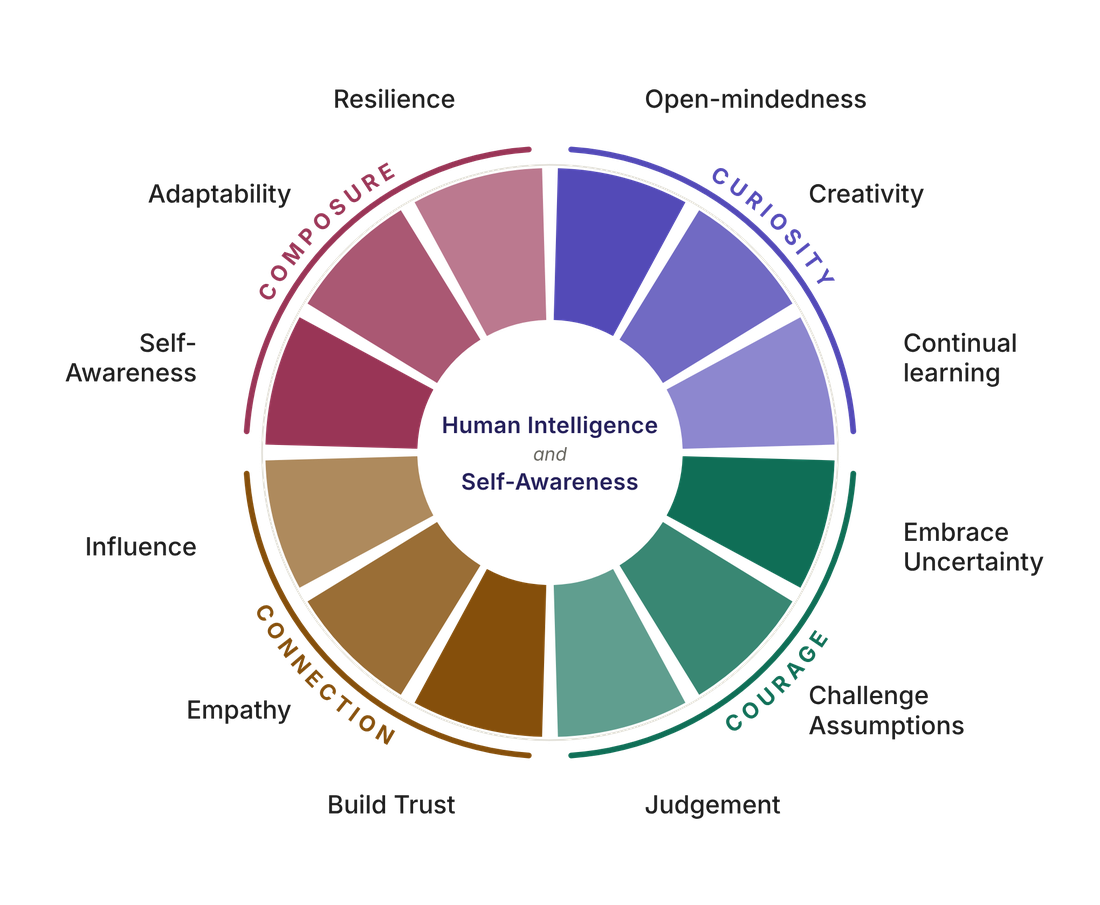
The 4Cs: the human skills that create value through AI
EQ4AI translates emotional intelligence into four practical capabilities, each built from three skills.
Curiosity
Open-mindedness · Creativity · Continual learning
Staying open to ideas that challenge your thinking, iterating past the first round of answers, and building new skills ahead of need.
With AI: more effective adoption, creativity and innovation.
Courage
Embrace uncertainty · Challenge assumptions · Judgement
Acting without waiting for certainty, questioning the status quo, and making and owning judgement calls under pressure.
With AI: confident decisions and action, even when the answer isn’t clear.
Connection
Build trust · Empathy · Influence
Building trust through honesty and reliability, understanding what people are experiencing, and bringing them along.
With AI: stronger relationships and psychological safety through change.
Composure
Self-awareness · Adaptability · Resilience
Noticing your reactions under pressure, adjusting course as things shift, and recovering from setbacks with a growth mindset.
With AI: managing change, and the anxiety AI can bring, calmly.
From
- Will AI take my job? What if it’s better than me?
- Can I trust the output? Who do I trust to help me decide?
- This looks great, but is it actually good? How do I know it’s better?
- What happens if I do something wrong or make a bad decision?
To
- What do I contribute that’s unique to me, that AI can’t do?
- What are the gaps and watch-outs in this output? What do my workmates think?
- How can I build on this idea? What other sources can I use?
- Who can I brainstorm this with? How can the team help?
The evidence
Grounded in research, built to help organisations empower their people
What leaders told us
The Lead With Us Listening Tour: 40 in-depth interviews with senior leaders, revealing consistent human capability gaps.
The science of EQ
Daniel Goleman’s emotional intelligence model maps closely to the gaps leaders described.
Global workforce research
The World Economic Forum and McKinsey rank curiosity, resilience, adaptability, empathy and collaboration among the most in-demand skills for 2030.
Inside the Listening Tour
Between September and December 2025 we asked 40 Chairs, CEOs, C-suite leaders and People Directors one question: what business challenges are you facing today, and how is that affecting your people on the ground? The answers were consistent. Organisations are investing heavily in AI tools at the expense of developing the human capabilities needed to embed AI in a way that adds value, not just efficiency.
Mindset before tools
AI upskilling without the right mindset will underperform. Self-awareness and human skills come first.
A middle management capability gap
The “squeezed middle” is carrying the heaviest load with the least support.
Honesty builds trust
Transparent conversations about AI build more trust than over-stated narratives.
Psychological safety drives innovation
Without the confidence to challenge and speak up, work becomes mediocre.
“AI skills training will be obsolete in a month. Human skills are durable and will become more important.”Senior leader, Listening Tour 2025
The EQ4AI assessment
Where do you stand?
See how you show up across the 4Cs at work today. There are no right or wrong answers: just how often each behaviour reflects what you actually do.
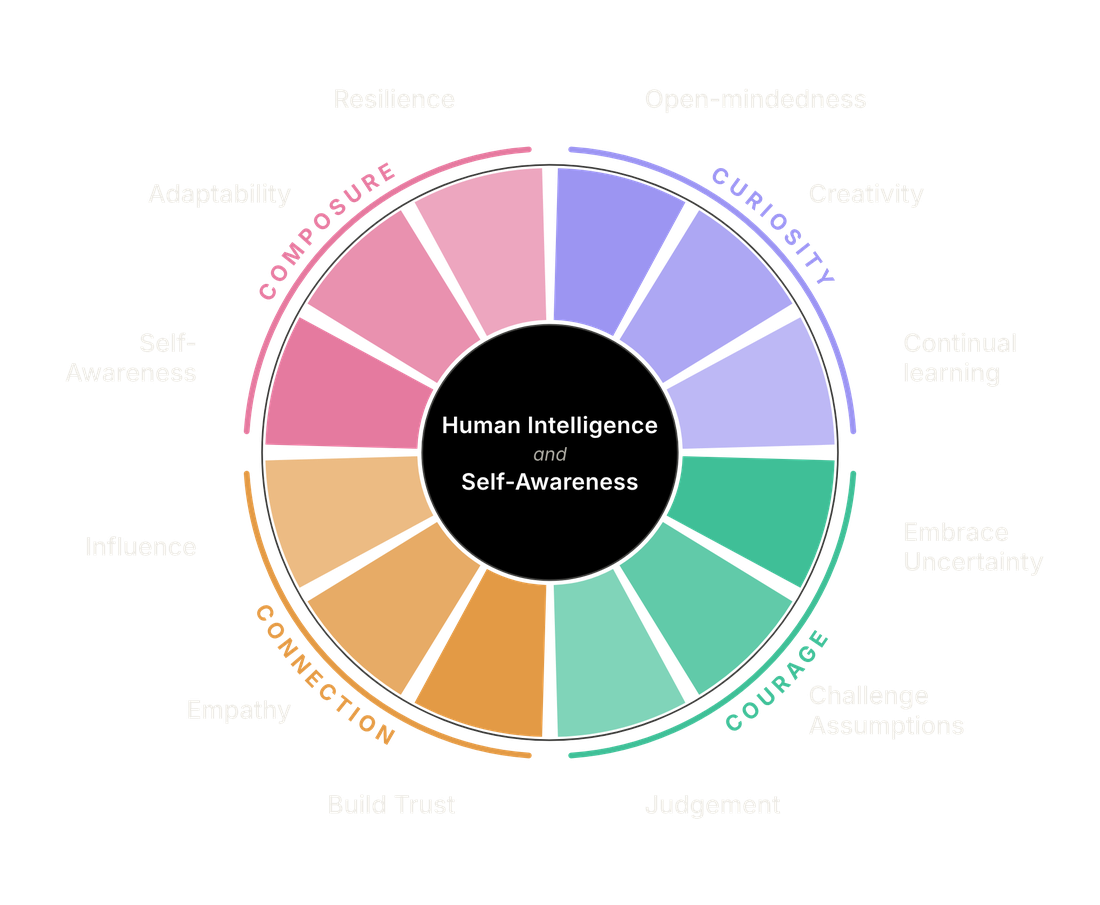
- Your 4Cs profileA petal chart of your 12 capabilities across Curiosity, Courage, Connection and Composure.
- Your strengths and growth areasWhere you’re strongest, and where focused practice will make the biggest difference.
- Practical next stepsSmall micro-habits and development actions you can start applying at work straight away.
EQ4AI is a research-informed reflective tool, developed with Chartered Psychologist Dr Leigh Morris. It supports self-awareness and development; it doesn’t diagnose or rank. Responses are kept for up to 2 years. Employers only ever see anonymised group results. Questions: kat@katsocoaching.com · Privacy policy
Run it with your team. Social desirability bias can influence individual results. Taken across a team, EQ4AI gives you a truer, anonymised picture of where your people’s human skills are strong and where the gaps sit: a practical baseline for your AI plans.
Talk to us about a team assessmentThe EQ4AI programme
From AI use to AI value
AI transformation needs three conditions. Most organisations have invested in the first. EQ4AI builds the other two.
-
Assess
Find the starting pointUnderstand your organisational challenge, human context, readiness and capability gaps using assessments and diagnostics. Identify the starting point and what success looks like.
-
Create
Design the programmeDesign a tailored human-AI skills programme around your needs, incorporating workshop design and individual and group sessions.
-
Activate
Practise on real workBuild confidence, practise new skills and apply them to real AI work through facilitated workshops and 1:1 and group coaching, using live AI use cases.
-
Embed
Sustain and measureSustain new behaviours, integrate new workflows and measure value, with follow-up group learning and reflection sessions, pre and post assessment comparison and programme evaluation.
Who it’s for
Media, marketing and communications businesses whose people are using AI, but who aren’t yet seeing the growth, innovation or ROI they expected. We work with leadership teams, horizontal groups and the organisation as a whole.
Team assessment
An anonymised 4Cs baseline for your team or leadership group.
4Cs half-day workshop
Shared language, practical tools and a personal commitment plan for every participant.
Full EQ4AI programme
All four steps, tailored to your organisation and scoped with you.
What clients say
Trusted by leaders in high-pressure organisations
“Kat designed and led a programme of half-day leadership workshops for our senior client leaders, from EQ and relationship management to navigating difficult conversations. The sessions were both credible and immediately applicable. Feedback from the team was overwhelmingly positive.”

About
Kat So
Founder, EQ4AI · Executive and systemic team coach
I spent more than 25 years leading complex global businesses in media agencies across London, Sydney and New York. Most recently I was a Managing Partner at Initiative (now Omnicom Media) and MEC (WPP), leading top 10 global client accounts including Nike, LEGO, IKEA and Citibank, and serving on US leadership and advisory boards. I know first-hand what it takes to lead through uncertainty, motivate disengaged teams and sustain performance against a backdrop of anxiety and significant change.
Today I’m an ICF-certified executive and systemic team coach with a BA in Social Psychology. I combine that business experience with expertise in emotional intelligence, psychological safety, resilience and team development, using tools such as BeTalent’s Resiliency and Psychological Safety assessments, Principles You and Principles Us (for teams), and the Leadership Circle Profile.
I created EQ4AI because AI adoption isn’t only a technology challenge. It’s a challenge of core human skills: emotional intelligence, confidence, trust and judgement. That’s where I help.
“She’s great at reading a room, cutting through noise and helping diverse stakeholders get aligned to make progress quickly.” Chris, Brand Director, Nike US
“A natural coach and mentor, she’s someone who creates trust and inspires high performance.” Tom, Director, LEGO US

Dr Leigh Morris
Chartered Psychologist · Co-creator of the EQ4AI assessment
Leigh is a Chartered Psychologist, an Associate Fellow of the British Psychological Society, a Chartered Scientist and a Fellow of the Market Research Society. He has a PhD in Social Psychology, exploring the role of leader influence on group decision making.
In 2005 he founded Bonamy Finch, which grew to be a leading UK consumer strategy and insights consultancy and was acquired by STRAT7 in 2019. Today Leigh’s consultancy focuses on growth strategy, market segmentation, insight and analytics, and business exit planning.
Get in touch
Let’s talk about your people and AI.
If your teams are using AI but you’re not yet seeing the value, let’s explore what’s getting in the way. A 30-minute conversation is a good place to start: no obligation, just a practical look at where your people are today and where you’d like them to be.
Or email kat@katsocoaching.com · Connect on LinkedIn · Not ready to talk? Take the assessment first